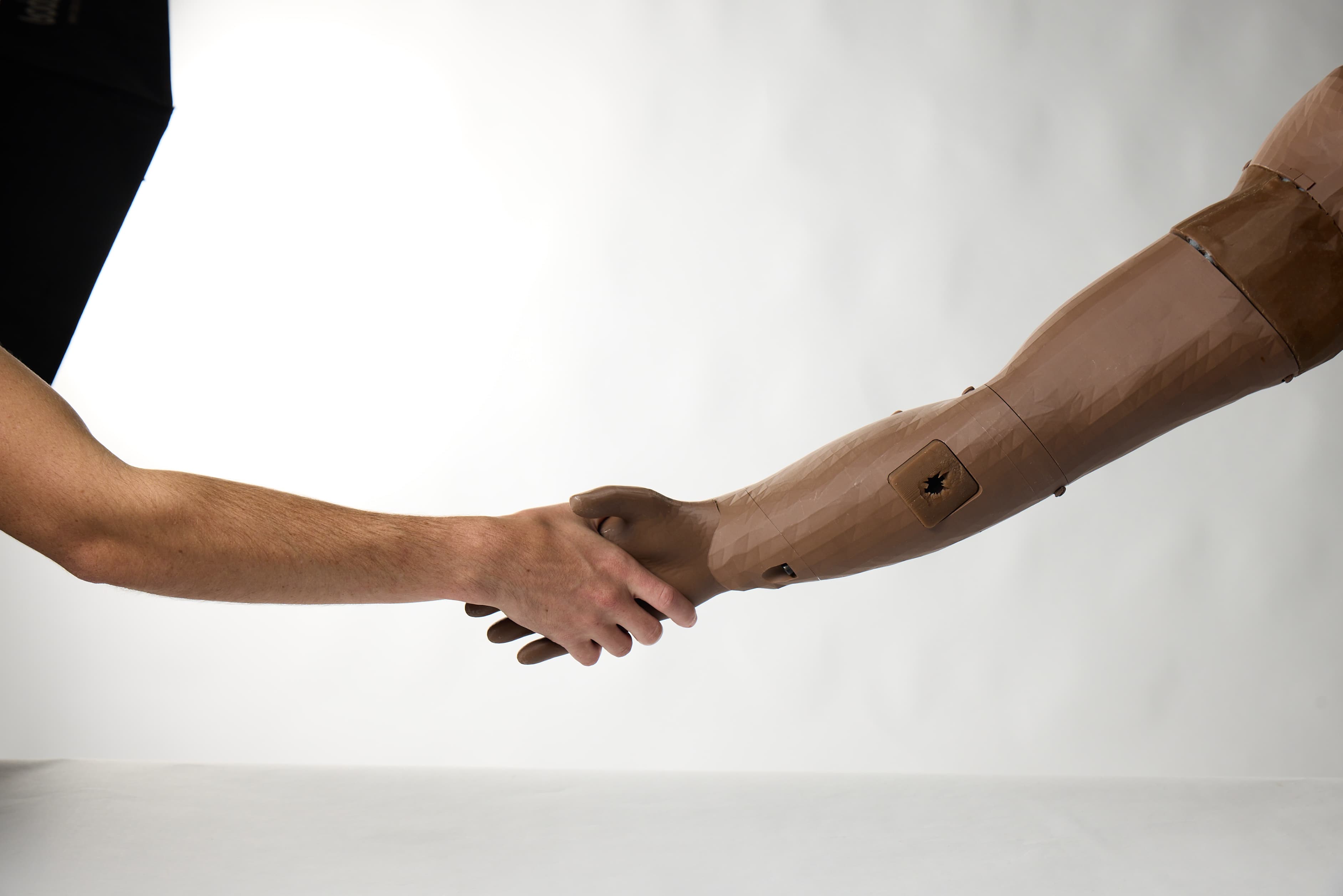
Most trainees never find out whether their tourniquet worked.
Our task trainers bleed until they get it right.
Training looks different depending on who's in the room.
Tell us who you train and we'll show you what's relevant.
The arm bleeds.
This is what a trainee sees when they walk up.
Active bleed. Apply the tourniquet, or pack the wound.
Same arm. Different casualty. Thirty seconds to reset. Then the next trainee steps up.
Get a closer look.
Both trainers in full 3D. Drag to rotate.
Setting the stage…
Skin tone
Every unit is cast to order. Pick the silicone tone your scenarios call for.
Includes 3 wound blocks (bullet entry, bullet exit, and gash wound) and hand pump.
You don't need a whole mannequin to teach a tourniquet.
Our trainers do hemorrhage control completely, not twenty skills adequately. A full-body simulator is a general-purpose platform that happens to include bleeding. Ours are purpose-built for the one intervention behind most preventable trauma deaths.
The only trainer where the wound changes. Patent pending.
- Modular sections replace individually. You never scrap the unit.
- Made to order in-house. 2–3 week lead time on orders of about 10 units or fewer.
- Fast setup and teardown. Instructors report long setup is a real cost of full-body simulators.
Compare the tiers in detail
| Tier | Cost range | What it does | Where it falls short |
|---|---|---|---|
| Improvised & basic aids | $0–$300 | Something to wrap | No feedback. The trainee cannot tell if it worked |
| Anatomical props | $300–$1,500 | Looks like a limb | Does not respond to flow control |
| Responsive limb trainers | $2,000–$6,500 | Bleeds, responds to correct application | The wound profile is fixed. Same scenario every time |
| Full-body simulators | $10,000–$100,000+ | Broad capability across many skills | Instructors report durability issues, long setup and breakdown, and generalist depth |
| RD Medical Training | $2,000–$3,000 | Hemorrhage control, purpose-built: the wound profile changes between scenarios | — |
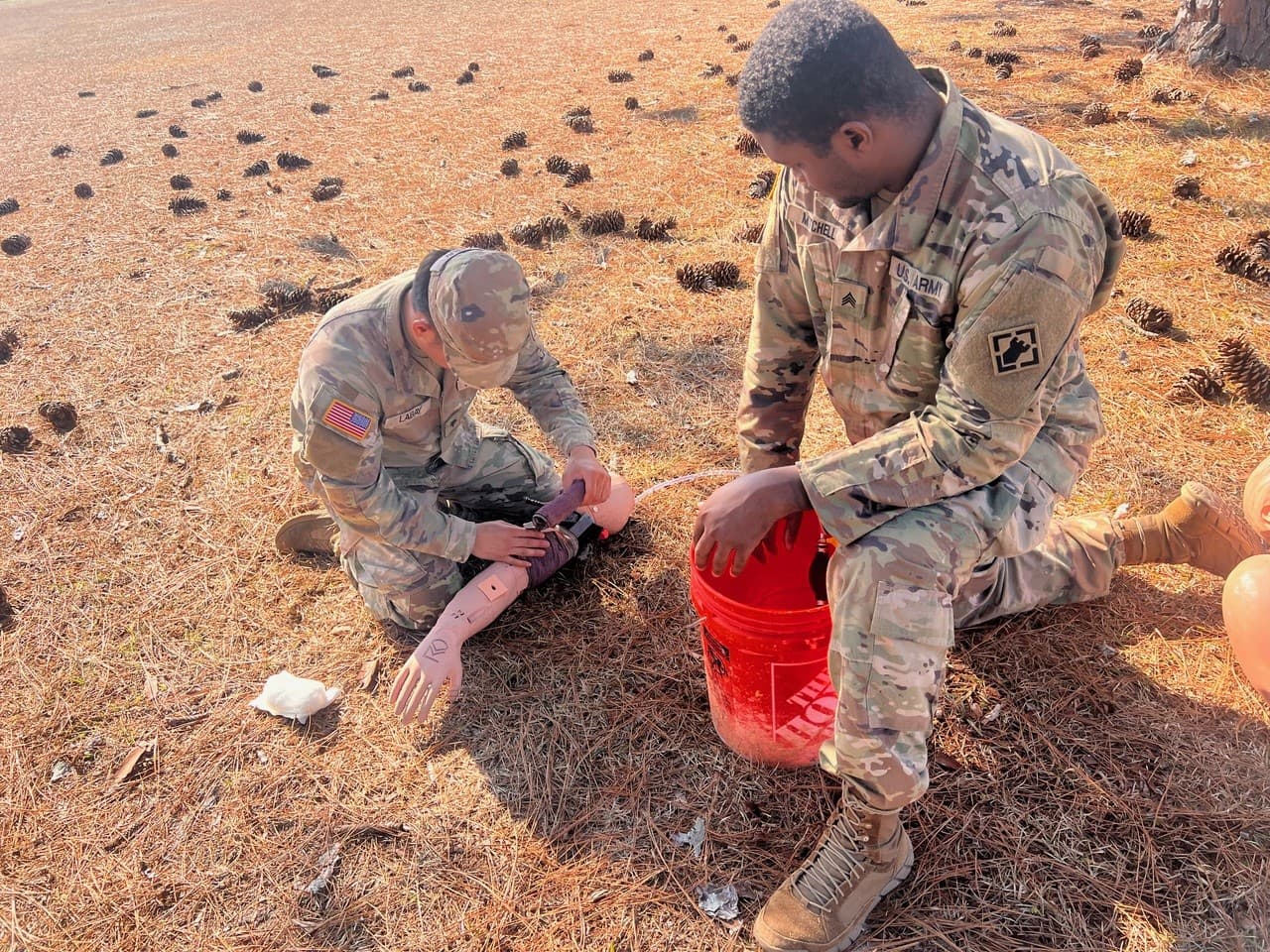
Already in the hands of the people who need it.
“Your goal should be to get these to as many units as possible. They're going to save a lot of lives.”
In the field with






Supported by
Advanced Technology Development Center · VertX Partners · Georgia Tech APEX Accelerator · Beacon Point Associates
Where we came from.
- 01
Fort Stewart.
The Army hired two biomedical engineers to fix TCCC training aids.
- 02
We asked the medics.
Realistic, durable, and variable training.
- 03
The Army said keep going.
It transferred the IP to us so the work could continue. That became the company.
- 04
Today
In the field with military units, EMS agencies, fire departments, police, and colleges.
What is better training worth?
Four questions. Your numbers on screen before we ask for anything.
Question 1 of 4
Your numbers land here.
Answer the four questions above and we'll size a package for you. It takes about a minute, and nothing is sent anywhere.
What hands-on practice does
12% 92%
In a published study, about 12% of ordinary people could correctly apply a tourniquet before hands-on training. After it: 92%. Watching a video doesn't do that. Practicing on equipment that responds does.
And the skill fades
40%
of trainees could no longer apply a tourniquet six months after a one-time course.
Bleeding control isn't learned once. It's kept with regular, realistic reps, which is what more stations and more hands-on time per trainee buy.
The bar this purchase has to clear
0.2%
The federal government values one life at $14,100,000. If our training equipment creates even a 0.2% chance of preventing a single death, this package has paid for itself.
For scale: in the study above, hands-on practice moved the share of people who could stop the bleed by 80 percentage points. The bar here is 0.2%.
How the break-even percentage is calculated
Total cost is the price of the recommended arm and leg trainers, plus replacement wound blocks over the device's lifetime. That total is divided by $14,100,000 — the U.S. Department of Health and Human Services' standard value of a statistical life used in federal regulatory analysis — to produce a break-even percentage. A lower percentage means fewer prevented deaths are needed to justify the cost.
Sources cited (5)
- Petrone et al., The American Surgeon, 2023: correct tourniquet placement rose from 12.8% to 92.3% among civilians (17.4% to 94.8% among security personnel) after hands-on Stop the Bleed training.
- Weinman, Journal of Emergency Nursing, 2020: 39% of trainees were unable to apply a tourniquet successfully six months after a bleeding-control course; mean skill scores fell from 100% to 69%.
- HHS ASPE, Standard Values for Regulatory Analysis, 2026 guidance (2025 dollars).
- SGLI maximum coverage $500,000 plus death gratuity $100,000.
- CDC MMWR, State-Level Economic Costs of Fatal Injuries, United States, 2019.
Leave with your numbers.
Coming soon: the same trainer, in mixed reality.
A casualty that moves, breathes, and talks, layered on the arm you just built a package around. The hands-on part stays real.